DANFO MELLOW, ST. LOUIS GIN, AND BERLIN TECHNO
A CONVERSATION ON SOUND, CULTURES, AND TASTE
by Lara-Mareen Foerster
Emeka Ogboh visited St. Louis this spring as part of his sound installation “The Song of the Germans” at the Kemper Art Museum, which was featured in conjunction with the symposium “Archiving the Sounds of German Culture: A Century of Collection, Curation, and Creative Practice.” Our editor Lara had the opportunity to sit down with him to talk about his creative practices.
TERN: You might be wondering why we, a translation journal, invited you as a multisensory artist to have a conversation. Well, the etymology of the word “translation” does not encompass literature per se; the Latin word translates to “to carry across”. This can also mean to bridge cultures, and we believe this is what you are doing as an artist who focuses on migration and carries Lagos sounds across the globe, and why you are here with us today.
Maybe we can start with an icebreaker: What are the three most distinctive components of sound in Lagos? If you were only to name three.
Emeka: (laughs) I would say the sound of the vehicles, especially the horns. People use it indiscriminately. Second, the power generator, because of the power cuts in the city. The rest would be human sounds, which hover around them—religious activities or social activities. For me, I would really say these are the ones. I did a lot of recording in the bus stations. I was really interested in the vocals from the conductors.
TERN: You do have quite a lot of installations on the danfo bus. Do you ever feel tired of listening to it?
Emeka: I don’t feel tired of it since I’m working with it outside of Lagos most of the time. For example, in Berlin it keeps me rooted in the city, there’s a psychological aspect to that. It’s not something that I get tired of but I anticipate. I think the tiredness comes from recording because many times it sounds the same. I’m not recording Lagos at this moment since the city is undergoing a lot of transformation. I’m curious to see where this leads to before I start recording again.
TERN: Do you think about a particular audience when you record and plan for your installations, or is it more connected to the place and space you’re working in? I guess both aspects can be relational.
Emeka: You have to think about the audience. And you have to think about the location of where the artwork is going to be. You want to make sure your art works in a space, and you want your audience to understand the message.
For example, when I thought about one of my installations on the sound of Lagos, I did think about a Nigerian audience. I thought about who recognizes the sound, the ones that are familiar to you. Because prior to that, I was always interested in people that are not familiar and their reactions. When I was installing sounds in the context of migration, I started looking out for those that know the sound, because they don’t expect that sound in this specific space… since the sound has been translocated.
In the case of the Venice Biennale, you can’t plan on it because it is an international exhibition. It’s not just for the locals in Venice. You don’t have a clue where the audience is coming from, but the point is – you want to present your work well for whoever comes into the space to experience it. You still think about the audience, but not in the context of locality or nationality. It’s not like I make a work about Ibo music and expect only people who understand the words to experience my work. You are thinking about presenting it in such a way that even when someone does not understand the lyrics, they can still feel the music. The emotions are there, even if the language is not decoded.
TERN: When you are trying to stay authentic to places and cultures, let’s think about Lagos’s soundscape for example, how do you think does this sound transform in a museum space? And how do you make decisions about what is left out and what should be included?
Emeka: It is still authentic. It’s different from paintings and decisions on what to hang on the walls. I wouldn’t say its complicated to transfer sound in a museum context, just instead of outside, now its inside. You’re still going to hear those complexities.
In terms of treating the sound, it depends. Of course, if I’m presenting it raw, it stays raw. But usually you are editing. If you did a two hour recording, you could end up showing fifteen minutes maybe. How do you want to tell that story? You might have moved around. Do you want to tell the morning until evening, or choose the morning because the energy was more intense then? By midday, the sound drops a bit, then by rush hour it picks up again, at the market you can feel the flow. When I record at different moments in a place, then I try to bring in a selection of each moment.
“I think sound has that potential to keep giving.”
TERN: In your exhibition “The Way Earthly Things are Going II” (2025) in São Paulo you focused on ecological damage and loss, and you have worked with sculptural elements and light but also sound, scent, and smoke. What have you observed through your work or personal experience that led you to an understanding that other senses than the visual play an important role in shaping cultures, identity, or memory?
Emeka: In São Paulo the sound, smoke, the smell of the burning forest, and the red light, it was quite intense and apparently it was very emotional. They come in, they stay a while, they’re smelling the burned forest. And many of them leave with the smell of smoke in their hair and clothes. I wasn’t thinking about pushing people’s emotion per se. People had walked up to me and told me that they cried because of the installation. You know, it’s not typical when men come up to you and tell you that they cried during your art.
Let me tell you a story. In spring 2011, I installed the Lagos soundscape in Helsinki for the Cotemporary Art Museum Kiasma’s “ARS 11 exhibition.” It was two installations, one indoor and one outdoor. I was doing the outdoor installation, when they called me, telling me someone wants to talk to me. It was—I didn’t know he was Nigerian then—this young black man and he just held me, very emotionally. I was wondering what’s going on. Then he told me he was from Lagos.
He has been living here in Helsinki for three years and hasn’t gone back since. Usually, he will come to the bus station close to the museum, where the sound was installed, to take a bus to his work. On that day, he did the same thing, but he when he got there, he was hearing Lagos, and he felt disoriented. He said: “Oh, I’m here, I’m here in Lagos!” looking around and seeing all these white people…
He called his friends to say, “Something strange is going on. I’m hearing Lagos.” His friends thought he was going cuckoo. So, they said, “Listen, don’t go to work today. You’re working too much. Just come back home, don’t go to work.” He even thought his parents were trying to use voodoo to bring him back home because he was hearing voices. However, he then followed the sounds and walked into the museum. This was the last place he would think of Lagos sounds.
TERN: You have said that São Paulo has an energy that must be felt, the “energy of the masses,” especially during carnival. Europen cities, in contrast, are quiet to you. And then you have traveled to different African capitals as well like Cairo, Dakar, Addis Ababa. From all the places you have seen, what makes you think that listening habits and how we perceive sounds are cultural?
Emeka: African capitals in general are pretty loud. And they have similar structures, especially the parts apart from North Africa. You have many similarities—busses, stations, and the bus conductors driving through the cities and calling out the routes. What makes a difference are the languages.
TERN: I also thought about the relationship between religion, sound, and the city.
Emeka: Since North Africa is predominantly Muslim, the sounds of the prayers are everywhere. In many streets, you’re gonna have one mosque or two. But Nigeria is mixed. You have predominantly Muslims up North and then in the South is mostly Christians. And then of course it’s also seasonal. During Christmas you’re going to hear a lot of Christmas songs. The same with Islamic celebrations. But for me, stepping out of the Alexandria train station and being in downtown Cairo: that intensity is similar, the energy was like Lagos. Those cities do not have laws on sound, no use of noise ordinances. Sound is pushed. It’s not limited, it’s not governed, unlike in Europe. You can honk your horn anyhow—rules of loudness are cultural.
And when I say the government controls that, it also extends to you having a party at your home and your neighbor is now waiting for 10 PM to get you down. I’ve DJed in a few places in Berlin. The last time I DJed at a rooftop bar, at 10 p.m. I had to cut it off. They said a very famous film star, an actor, lives close to this place, and he always pulls the phone. Everyone is waiting, looking at the watch, and then—it’s 9:59pm. They are just ready to die out. Just shut down when the energy is building up.
TERN: Since you mentioned sound ordinances, I’m curious how this influences your outdoor installations. In Germany, we have Street Music Regulations and unannounced public performance laws, for example. Have you ever received negative feedback on your installations?
Emeka: Exactly. You need permission. In Cologne a long time ago, it was probably 2010, my installation was just outside a building. For some people that was too much. And that is so funny because Cologne has carnival, it’s one of the wildest things you want to see. But then people broke the speakers a few times, even though we had permission. Some people are bothered for whatever reason.
But there were people that liked the installation. There was this one guy who came every morning. He would just have his coffee and spend time there. And I walked up to him and I talked to him. I wanted to see why he was there and he said, “The city is just too quiet, too blunt.” So he comes to have his coffee there and just spends a few minutes, it was a kick, you know? There’s been many reactions and different reactions. It’s not always positive, it’s not always negative.
TERN: Do you have the feeling as a sound artist you hear things that other people don’t hear?
Emeka: That’s the fascinating part about soundscapes. Sometimes, I recorded something long time ago that I’ve heard over and over again. When I listen to it today, I could hear something that I didn’t pick up before. This is applicable to all sounds and to everyone. We’re all going to hear the general sounds, but there could be something only you could pick up entirely. It’s the same with music.
For example, there was this one day in the car with my friends, they are like: “Oh, did you hear what this person said?” and I replied, “No?”
It was Nigerian Afrobeats. Someone suddenly says: “Ich liebe dich” (I love you). It’s German! I never realized it before and it was a line of the chorus. Because I was thinking of it as Afrobeat, I wasn’t expecting to hear German until someone who has more an ear for German heard that track. I think sound has that potential to keep giving.
“Ich bin ein Berliner [I am a Berliner] but I know that the Lagos in me will not leave.”
TERN: During your public discussion at the Kemper Art Museum, you said that you have been inspired by the Berlin electronic music scene. I am aware it is more diverse than this, but if I stereotypically think about Berlin EDM, I would describe it as dark, atmospheric, mechanical, and it has this in-your-face attitude. I listened to all your music tracks and would characterize them as more groovy, more varied in rhythm. Do you have any specific source of inspiration when producing?
Emeka: I am not necessarily sticking to that genre that defines Berlin. I think everything you said about it is true. My music is groovy because I also come from a different place. It is Lagos in it, right? When I say Berlin inspired me to make music, I didn’t want to start making music like people in Berlin. I remember getting into the Berlin sound scene and I realized it wasn’t my thing, it was too mechanical for me. But if I was elsewhere, I might not be thinking about making music. It was more about being in that scene. I wanted to make electronic music. The most important thing was how to use the softwares. That was my major interest. When I achieved that, I just started making music the way I felt. I make music by intuition.
TERN: In previous interviews you have talked about the automatized voices in Berlin trains, you can find the same mechanized voices and rhythm in techno. For me, part of your music is also this embodied characteristic of Lagos in comparison to Berlin. Is this just coincidence or is music maybe influenced by the sounds of our environments?
Emeka: Right, it’s all mechanical. You know what you will hear, when you go to the train stops. In Lagos you have the voices of different bus conductors and everyone tries to bring in their style, they want to make it unique. And even though they are all going in the same direction, the vibes are different. It’s more organic, it’s more dynamic.
TERN: And your track “Danfo Mellow” is exactly about that. Can you imagine a music piece about Berlin public transport?
Emeka: (laughing) I’ll tell you, this is what I sort of struggle with, because yes, “Ich bin ein Berliner” (I am a Berliner) but I know that the Lagos in me will not leave. I’m not going to delete or block out Lagos completely to make the music that is Berlin. It’s the same way in Lagos, the Berlin influence will also come. I’m always interested in the fusion of the intersection, not about the black and white.
I think one of the major things I learned being an adult is that there’s nothing bad. I wouldn’t recommend not to listen to something. I would say: listen to everything and see what you like and dislike, not based on someone else’s recommendation. It’s the same for art.
TERN: Maybe that’s a good transition to taste, in particular taste in food, another sense we have not talked about yet. In addition to creating multisensory installations and music, you have crafted beer, ice cream, and gin as part of projects exploring space and multiculturalism. I was wondering, if you were to design a project reflecting your experience in the U.S., what kind of food or drink would you choose?
Emeka: That’s an interesting question. You have met Zach Feldman. We just finished making a gin inspired by New York. New York is a multicultural city. It’s very diverse, and that’s what we try to do. We have been looking at the migration routes of people in New York. Apparently 8% of New Yorkers are migrants. We tried to trace where they came from and we looked at spices from that region. And we made this “Migratory Notes” New York Edition. This gin is eleven botanicals from different regions of the world.
With somewhere like New York, at the beginning, we had more than 20 botanicals. I think this is a good example. To answer your question, for me defining a city based on migration, locations, and stuff, it’s complex. And the truth is—you can’t please everyone. People will come and ask you why something is not there, and you have to decide how you’re going to approach that. It’s complicated because migration is complicated. I don’t want to do everything. I just like coming up with ideas and collaborate. Otherwise, it may end up being one-sided.
When I DJ, I actually play music for myself, and I don’t care. I’m going to put in what I like. But if you are going to create a project around migration, it’s not just about you. You try to make it as inclusive as possible.

Photo by Sylvia Sukop
TERN: Unfortunately, we reached the end of our time together. But we cannot let you go before we were asking you about your first impressions on St. Louis’s sound, cuisine, and culture!
Emeka: I didn’t think of St. Louis as laid back but it’s kind of laid back. St. Louis doesn’t hit you in the face, but it’s quite big with immigration or migration. Apparently, there’s a huge Bosnian community here. These were the stories I heard when I was out last night. I don’t think there are many people who have heard about St. Louis this way. And then we started talking about the possibility of making a gin project here. That’s what I want to pitch. We make this gin and then work with the food scene. It was a good outcome last night. It was inspring.
TERN: We hope this project comes true! Thank you for sitting down with us. We know this is a busy time for you.
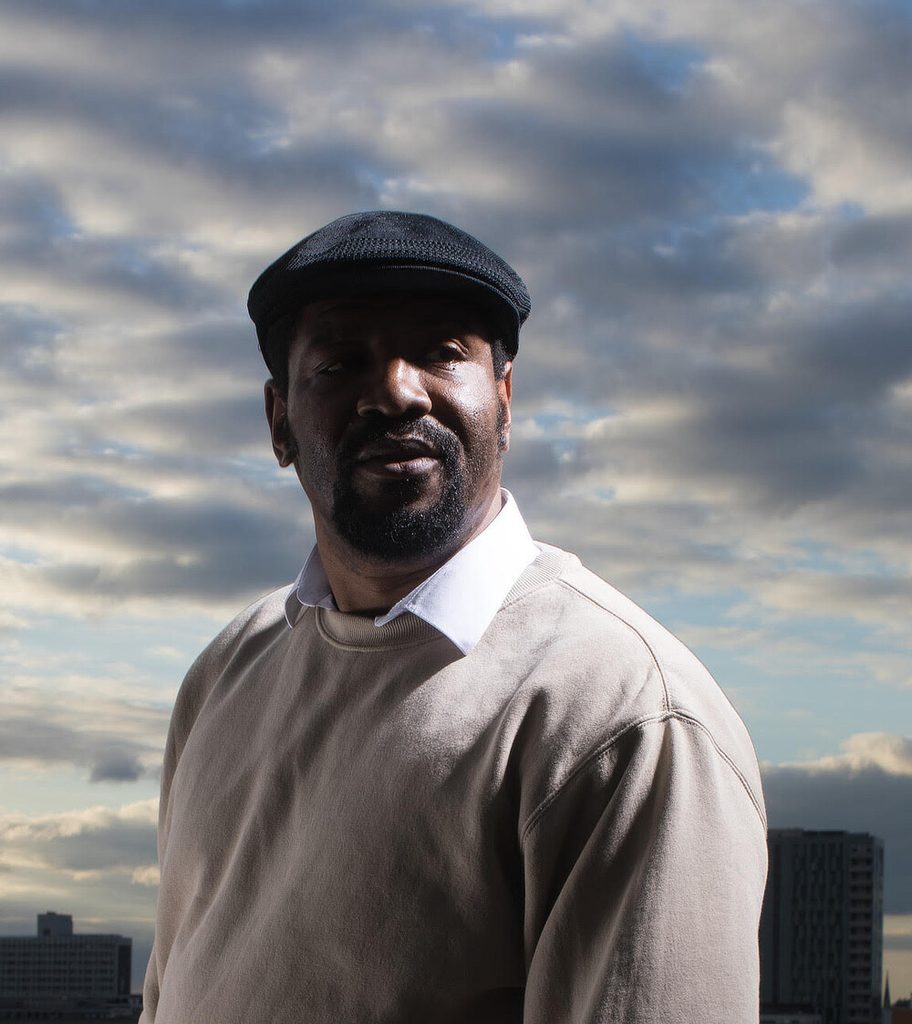
Emeka Ogboh (Nigerian, b. 1977) engages with place through a multisensory practice that extends across hearing, sight, taste, smell, and touch. His art installations and culinary creations incorporate various affective sensory elements to explore how private, public, and collective memories and histories are translated, transformed, and encoded into different perceptual experiences. Ogboh’s works delve into how sensory perceptions capture our connections to the world, shape our comprehension of reality, and offer a backdrop for examining critical issues such as migration, globalization, and postcolonialism.
Ogboh’s work has been presented at major international institutions and exhibitions, including the São Paulo Biennial (2025), Documenta 14 in Athens and Kassel (2017), Skulptur Projekte Münster (2017), the 56th Venice Biennale (2015), and the Dakar Biennale (2014).