An interview with Amira-Géhanne Khalfallah
by Lara-Mareen Förster and Stephanie Nebenführ
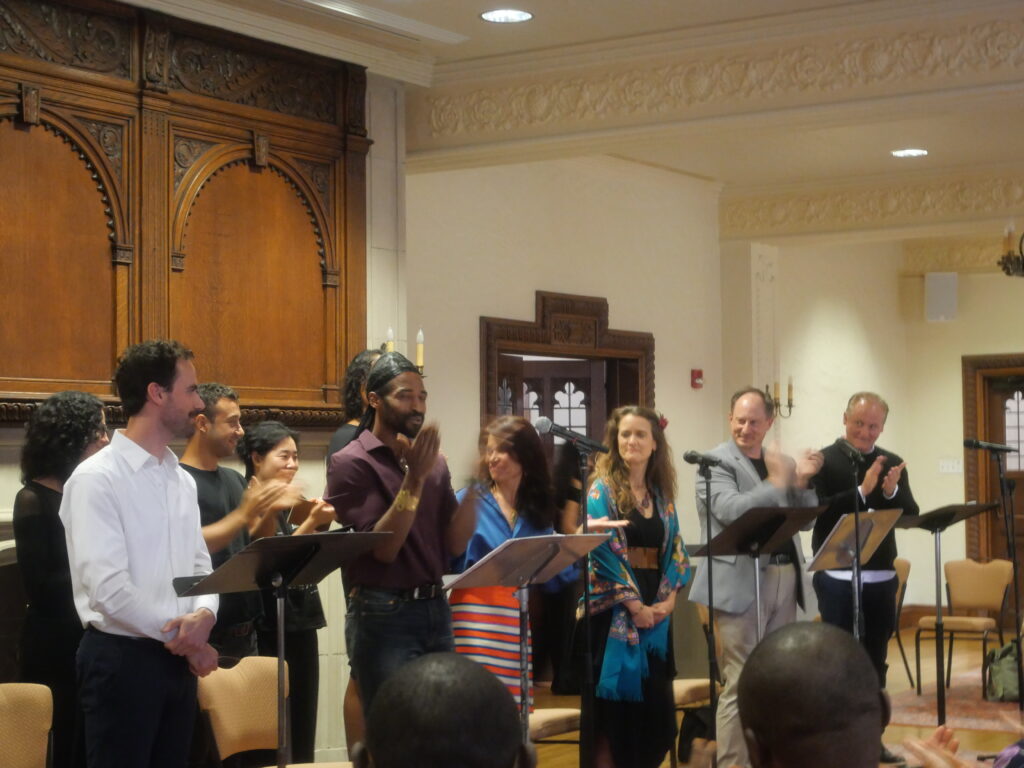
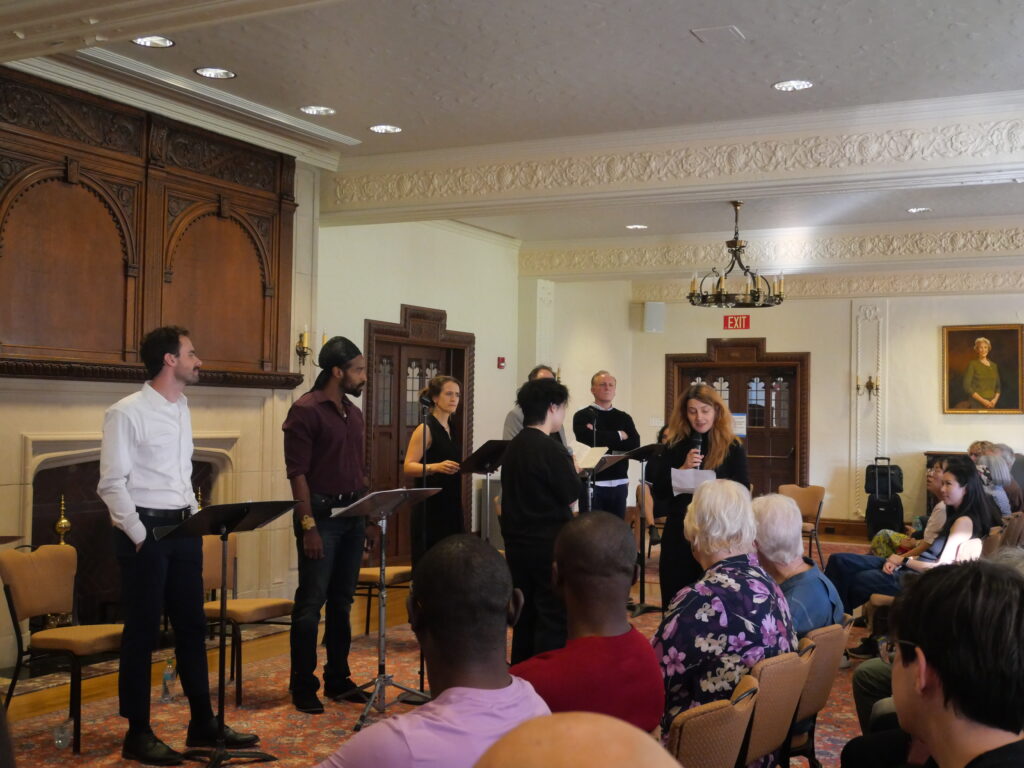
This past October, Amira-Géhanne Khalfallah, a PhD student in Comparative Literature and the International Writers Track at WashU, held a staged reading of her play, Hélène’s Dreams, followed by a panel discussion about the politics of translation today. TERN editors Lara-Mareen Förster and Stephanie Nebenführ interviewed Amira about inspiration behind the play, Amira’s origins as a writer, and other topics.
Lara: You first began working on your play quite some time ago. How did the idea originally come to you, and what did your writing process look like?
Amira: The first thing that happened was that I had this character of a translator in my mind. I had been interested, for years, in the idea of the translator’s visibility. We hear these voices, and we never know who is behind them, you know? Why should we make the translator invisible? I was developing this idea and writing on a train in France, (I find the movement of a train ride very conducive to writing!), but someone stole my laptop and I lost the whole work. I tried to rewrite the text later, but I really couldn’t find my way back to it. The character of the translator stayed with me though. That’s also how I write in general. I never start with a story. I spend a lot of time wondering with my characters before I start writing.
Lara: And then you end up rethinking everything again.
Amira: Yeah, and then something happens… it’s like being in a lab. But for this play, what came about was that I was commissioned by the French company Uz et coutumes to write a text about the French language. It was a big project, financed by l’Élysée, by President Macron himself. The play was planned initially for the opening of la Cité internationale de la langue française, in the Château de Villers-Cotterêts — the place where was issued the decree that made French the official language of France. I was asked to write a short play in relation to language; I really had no idea where to start from. I was still haunted by this translator, but at the same time, wondering what would the translator do? And somehow, I read about this guy, I think he was French, who had a stroke and suddenly started speaking Italian, even though he had never spoken it in his life. This case was called the ‘Italian patient.’
Lara: I also heard about an Australian suddenly speaking fluent Mandarin…
Amira: Yeah, it can happen in any language…the “Italian patient” was not only speaking Italian, but his whole behavior also shifted, even his taste and his eating habits. I started reading about this phenomenon; what happens in the brain, which zone of the brain controls language, and I was like — this is fascinating, it’s really all about embodying the language. I thought that I have to start somewhere, so I put this translator in, and…you know how translation is political, right? The story quickly unfolded around the election campaign.
Stephanie: Ali as translator or interpreter is the only connection to Hélène’s French environment. Can you say more about his position in Claude’s and Hélène’s house?
Amira: Ali was living with them because Claude couldn’t talk to his wife at all, so he needed someone there all the time to translate his wife’s words. But Ali’s presence in the space also completely changes their relationship dynamics. There’s an allegory about space in a postcolonial context here — what is colonization? It’s a claim on space. Space isn’t just the landscape; space also sounds, and smells, it is built in relation to the body. Hélène’s and Claude’s house is getting transformed by Ali’s presence, by the new words he brought to their lives. Female’s laughter is placed in conversation with language as well. Elaine Showalter calls it a “feminine protolanguage.” In the play, Hélène was moving the furniture, changing the decoration, space is in motion…this mobility is emphasized by smells, that’s why I included the cooking scene.
Lara: And is that why you chose to have people moving across the space speaking multiple languages in the beginning of the play – to give language an embodied form?
Amira: I would say this grew out of my desire to make international students voices heard and count. I thought, how can I express that? Let’s bring all the languages together and examine the resulting hierarchy. Which voice will fade, which one will emerge, what kind of listening experience will the audience embody…what acoustic effects emerge when we stage varying textures?
Lara: Since Claude believes in a “proper” French and seems to reflect a certain linguistic nationalism, how do you see that in light of current political debates?
Amira: Well, we’re talking about the “purity” of language. We all know languages are made of métissages. “All nationalisms are gendered,” claimed Anne McClintock, and all nationalisms are monolingual too! How can any political force stop the evolution of language, though? This is the premise of the play. How can we refrain the evolution of something that is alive? To me, Rap (and that’s why I added the Rap song) exemplifies these antagonisms; it is language, real and alive, in its most evolved form.
Lara: It’s so interesting that the play presents itself as being in French — everyone
appears to be speaking French, but it’s actually in English. Do you think the play functions as political satire equally well in both the French and U.S. contexts?
Amira: I wasn’t sure if it would work in the American context, but it did. I think sometimes, in times of political tension or crisis, we need distance, and theatre provides that.
The catharsis happens because, in this case, we can laugh at the situation. We don’t need to specify the country, or say that is about you or me — it’s about all of us. That’s what I love about theatre: Unlike in cinema, we rely on imagination. For example, we might bring a real plane in cinema if needed, but in theatre we use cardboard and tell the audience it’s a plane, or a sheet can become the sea. That’s the magic of theatre: The audience brings imagination to connect with others and allows the catharsis to happen.
Lara: I was thinking about the geographical context a lot. There’s the scene where Claude’s colleague Christian enters, and Claude lies about Ali being Argentinian, so suddenly Hispanic seems “better” than Arabic. We know these discussions play out differently in the U.S. context.
Amira: Exactly, I really like that. The relationship to Hispanic people in France is very
different — it’s more “fancy.” This again shows the hierarchy around languages and people: it depends on where we place them and when. It’s also tied to colonial history, especially between France and Algeria — the last country in Africa under French colonization, the longest one, lasting 130 years.
Lara: Something Stephanie and I were trying to remember – what region did you grow up in? You had mentioned after the play that it was a multilingual environment.
Amira: My city is called Jijel, on the Mediterranean coast, and even in Algeria, people don’t
understand us when we speak (laughing). It’s really a mix. My city is the matrix of the native
peoples of North Africa, the Amazigh, who were Arabized in the 7th century. So, we might
use a word in Amazigh but conjugate it in Arabic, and then slip in a word in Italian. In the same line, you can find French, Arabic, Amazigh, Italian, and Ottoman. I grew up with this
diversity, which I find really fascinating.
Stephanie: Speaking about growing up, what is the origin story to your writing?
Amira: I have so many versions of this story (laughing). So, I don’t know the true story either. When I was six years old, I wrote poetry. But I started writing seriously during the civil war in Algeria in the 90’s. I think this was really the moment that triggered my writing. It was at a time when we had terrorists attacks everywhere. My city was the stronghold of the armed wing of the Islamist movement of the time. There were a lot of massacres around, theaters and cinemas were targeted as well, actors and playwright killed. You couldn’t go anywhere. From fifteen to when I was twenty-five, I grew up in this terror. I started writing in the middle of this chaos. I also worked as a journalist during the end of the war, but I think I felt the need to write for the theater, specifically. Which was completely stupid, because we didn’t have any theaters during that time (I mean in my city). I think it started with theater because I couldn’t have access to public space. Completely anachronistic, but to me it makes sense, because I needed this connection to others. To find a space to tell stories.
Lara: And today you’re telling stories in different languages and spaces. Maybe one final question about the play’s multilingual dimension. How do you see it functioning — particularly now that it’s been performed for an English-speaking audience, which might differ from a French-speaking one? You employ the notion of a lingua franca,
are there any other ideas, theories, writers that have inspired your interest in this?
Amira: Yes, I like this. Of course, academics or translators will understand the theories woven in the script, but I also wanted it to be funny and understandable for everyone else. So, there are different levels of meanings — In terms of translation, for instance, there’s the “polyamorous” approach, when you embrace all languages, and then there’s “cannibalism,” when you just consume foreign languages and as Christian says in the play “better to eat them before they eat you up!”
Lara: Claude, in that sense, would rather be a representative of the cannibalistic approach, yet Ali is quite a polyamorous character. Stephanie and I thought the actors were perfect in their roles. Maybe more generally, what was the process like? Did the actors bring their own ideas about how to embody aspects of translation and intimacy?
Amira: We were really limited in terms of time, money and space to try things. All of us had great ideas, but we couldn’t really explore, so my work was just to say, “let’s stop here, let’s have something coherent, something that works in this moment of the process.” Because to really explore all of our ideas we need a proper stage. It’s not magic, it’s work. It’s hours and hours of being locked in a theater and trying things. And this is really what theater is. Nobody knows what will work or not. It is also the dynamic of the people that come together. Sometimes you come in with a great idea, and you see it on stage and realize: “Oh my god, this is terrible.” And other times, a rather stupid thing makes sense: “Oh stop right here, do this again!”
Lara: Do you feel like there was something lost in the translation?
Amira: Gayatri Chakravorty Spivak says the translator facilitates the love between the original and the shadow. To me there is no original and no shadow as it is self-translation. And I don’t think anything gets lost in translation, because I consider the result as something different. When we watch a film that is adapted from a novel, we’re always disappointed because “it is not like the novel,” of course it is not. It’s a film! I think we have to be more open…
We always want to experience the same feelings, atmospheres etc., but maybe this is the beauty of translation; to bring something new into the play. It is hospitality, acceptance. It is about welcoming another language, and sounds. At times, thinking counterintuitively is necessary.
Stephanie: What’s coming next?
Amira: I would love to go for a full production of this play. I’m thinking about that a lot.
Lara: You are hoping for the production to be in a French, English, or Arabic language environment?
Amira: I’m in the U.S. for now, so, I would love to find a way to do it here.
Stephanie: We’re looking forward to it!
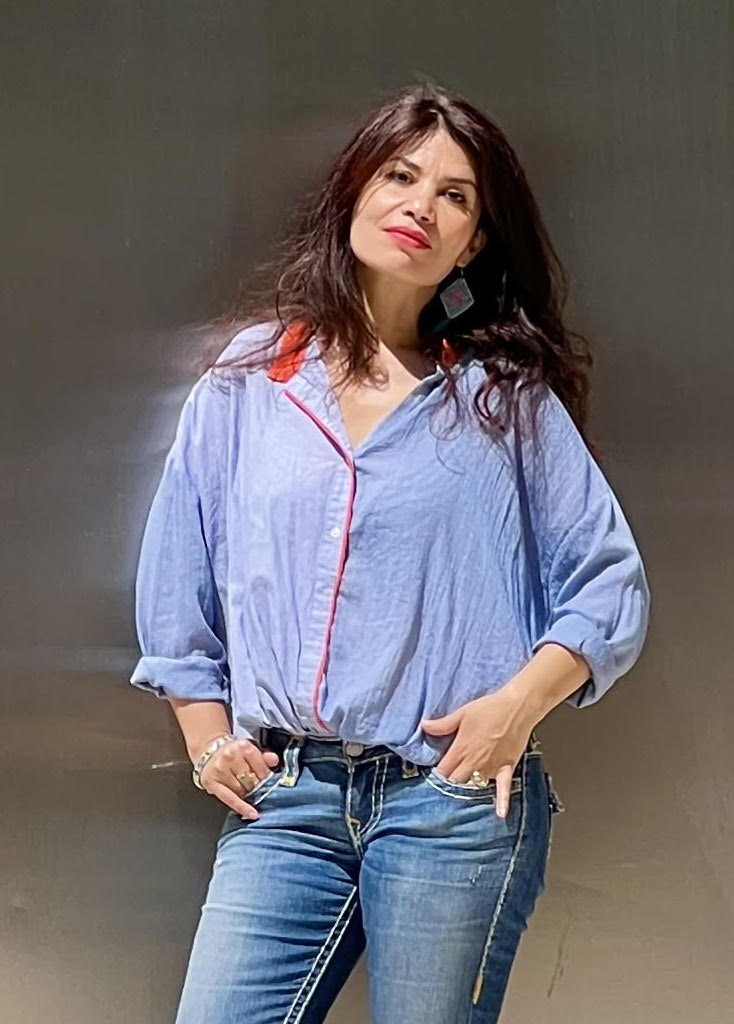
Amira-Géhanne Khalfallah is a novelist, playwright, and filmmaker. Her short film Miss received four international awards among them, the Special Mention of the Jury at Berlin International Film Festival (2020). Khalfallah published her debut Novel Le naufrage de La Lune in 2018 and authored seven plays. In October 2025, she staged a reading of her self-translated drama, Hélène’s Dreams at Washington University in St. Louis.