WHAT WILL I BE WHEN I GROW UP
translated from Hungarian by Marietta Morry and Walter Burgess
Translators’ Note: The narrator, a girl of about eight years old, attends a strict Roman Catholic school in a small city in Hungary. Children address older women as “Aunty;” this does not imply any family relationship. Father Gábor is the priest for the school.
Aunty Teri was standing on the stairs of the National Museum in Budapest and shouting. We were lined up in pairs and I grasped firmly the hand of Ferike Barabás, not letting it go while Aunty Vica tried to share with us the terrible news she received at the entrance to the museum that we had missed our time slot and couldn’t go to see the exhibition because it would be closing soon and everyone heard this and understood, except for Aunty Teri who could neither see nor hear and just kept on shouting: of all the damned things!
During the after-school daycare if someone misbehaved or didn’t obey her, the air around Aunty Teri was just as cold and the silence just as deep as in a church during the Sunday mass. Bence Fazekas practically froze at his desk whenever Aunty Teri caught him playing a game and looked at him with that ice cold stare of hers before walking over to the quite rigid boy to whack him on the behind then sent him to the corner where he had to kneel until the school closed or until we had to go somewhere in pairs, and that day when Bence Fazekas infuriated Aunty Teri so much that even his mother was summoned to school the next day, I didn’t dare to ask if I could hold anybody else’s hand than Ferike Barabás’s in the afternoon.
This was a disaster, a huge disaster. Even Aunty Vica didn’t help me, even though as my home room teacher and the one teaching religion, she would have had it in her power to help, but she didn’t as she said, not because she didn’t want to but because the rules clearly state that I have to hold Ferike Barabás’s hand and I should know that since we learned the alphabet and I was an all A student and knew the rules, I knew exactly that only two things could remedy my problem, one, if someone whose name is ahead of mine in the alphabet fails the year, the other if one of those pupils died, but since I liked seven of the nine pupils whose name preceded mine in the alphabet and six were good students I didn’t see much chance to get rid of Ferike Barabás, unless he is the one who somehow dies.
When the thought occurred to me, I right away remembered the Virgin Mary and hoped that she wouldn’t tell Aunty Vica or Father Gábor – not to mention Aunty Teri – that I had such thoughts in my head and, of course, I didn’t want anyone to die who was ahead of me in the alphabet, but I didn’t see any other way out, the girls could not yet get married to take their husbands’ name, the way my mom took my dad’s and in our school no one changed their name just like that, so I had to accept that I had to hold Ferike Barabás’s hand until the end of time, I had to sit beside him at the desk, had to walk with him to the gym class and the lunch room and hold his hand during our outings.
Ferike Barabás was in love with me. He was in love with me with his whole being, with his slight build, his thick glasses, his meek girlish voice, his scrawny white legs, which I hated to look at during gym class, especially because he stood beside Dani who had nice brown legs, fine soft skin and I was separated from him by only one person in the alphabet, one name: Ferike Barabás. It would only take one skip in the alphabet, and I could go everywhere with Dani, sit beside him during classes, hold his hand during excursions, but I had to sit beside Ferike Barabás and hold his hand. He wanted to give me his apple, he wanted to help me put on my knapsack, he wanted to help me with my homework, and I hated that everyone saw it, everyone heard it and I especially hated when they were chanting: Zsófi and Ferike sitting in a tree K-I-S-S-I-N-G … and when I asked Aunty Vica to help and move me to another desk, she grew sad that I was so nasty since Ferike only had good intentions, and I should give in and that way I would be free of him sooner, but I didn’t understand from what I would be freed or how I should give in, and from then on I never tried to involve Aunty Vica.
For the longest time I didn’t dare to ask Aunty Teri to let me sit somewhere else, at least during day care. Then one day when I saw that, for some strange reason, Aunty Teri was in a good mood and the air around her was pleasantly mild, I decided to be brave and talk to her. For lunch she drank Frankfurter soup. Aunty Teri drank everything from a glass, water, yoghurt, soup and if something got stuck to the bottom of the glass, she lifted it above her mouth, tapped on it and waited for the pieces to plop into her mouth, and she was so good at it that she never stained her nice white smock. After lunch an old priest came to visit us and we had to discuss with him what I will be when I grow up, what we will be when we grow up. His eyes sparkled so beautifully; he had such an impact on my classmates that two of the boys said that they wanted to be priests even when they had absolutely no intention of becoming priests when they grew up because the priests couldn’t marry and, in my class, even the homeliest boy was in love with someone. Even when it would be Bence Fazekas’s turn, he would pull himself together in front of the old priest, and stand by the blackboard without fidgeting, quite disciplined, and would say he wanted to be an actor. Katinka, the head girl, would give it a lot of thought before saying that she would most likely become a school principal, that is how she saw herself in the distant future. Later when it was Dani’s turn, he would state that he was going to become a journalist, after which the old priest pricked up his ears and said: wow. Ferike Barabás didn’t hesitate for a second, he said: electrical engineer, what else, his dad was also an electrical engineer and at that moment I thought it very boring that someone would be an electrical engineer or that someone would want to be one, awfully boring. Then the old priest suddenly turned to me and asked me the question: what will you be when you grow up, and even though he asked the same question of everyone ahead of me in the alphabet I was so surprised by the question that I couldn’t answer even though I always know the answer to everything, it wasn’t a coincidence that Aunty Vica and Aunty Teri called on me when they needed an answer to the big questions in life, the correct answer, but all of a sudden I couldn’t tell the old priest what I wanted to be, I got all hot and thought that the old priest would be happiest if I said nun and Aunty Teri would like to hear teacher and I couldn’t remember what my grandpa or my mom would like best but when I thought about my dad at that point I didn’t understand why I needed the think so much when the answer is so obvious, my dad told me that I would be a dermatologist or a civil servant because they don’t have much work to do and make truckloads of money, and then I looked the old priest in the eye and told him I would be a dermatologist or a civil servant.
Aunty Teri was smiling all day long. When Zsuzsi went to the blackboard to say that she was going to be a veterinarian, Aunty Teri sat down at her desk and continued smiling there while her place was taken by the old priest. As I was watching the smiling Aunty Teri, around whom the air has never been at such a pleasant temperature, I recalled the decorum in church and I thought that the same rules applied to Aunty Teri now as to me during the mass that no matter what happens she has to stay seated, she is not allowed to make any noise, cannot run around and cannot scold me as long as the old priest is in the room, and then I quietly told her in a whisper so no one else could hear what I would like, but I was wrong, very wrong when I thought I could catch Aunty Teri on such a pleasant day, because when she heard my request about wanting to sit somewhere else except next to Ferike Barabás, the smile froze on her face and she looked at me so coldly and so strangely that right away I felt ashamed and I knew that I had done something stupid, and when the old priest left, Aunty Teri stood in front of the class and told everyone what I had asked of her and everyone, even poor Ferike Barabás heard it and then Aunty Teri made me stand up and asked what exactly I wanted to be when I grew up and let out a mocking loud laugh and said with such an attitude I would not amount to anything.
We also used to attend the Act of Adoration with Aunty Teri. The Act of Adoration is the longest thing imaginable in the whole wide world, it is so long that even grandpa never attends it, longer than the Rosary, much longer than the Angelus and its text is so tangled and weird that it is impossible to remember. I was struck by a few peculiarities in the mass as well to which I had never given thought before, for example that Jesus is the Lamb of God or Jesus is the Good Shepherd and that, according to Father Gábor, I am also a lamb like Jesus, but if I am a lamb, I figured that Aunty Teri must be a shepherd because she keeps herding me, and if Aunty Teri is also a shepherd like Jesus, then Jesus is not that nice after all, but all this was nothing compared to the Act of Adoration from which I could only recall a few lines. I was completely confused by these lines “Body of Christ, save me” or “Water from the side of Christ, wash me” and when I asked grandpa why water was gushing out of poor Jesus’ side he replied that when someone’s body is pierced the way Christ’s was before the Crucifixion there is also water pouring out of the wound and, according to the text of the Adoration, we have to wash ourselves in that water and gain salvation through Christ’s body and before that, earlier on, I didn’t know that poor Jesus’ side was also pierced and not only the hands and feet had nails hammered into them, and then I felt really sorry for poor Jesus because those things must have hurt terribly but I still didn’t understand how I could bathe and wash myself clean in that water and especially didn’t know what Mary and the others under the cross would say about that, and what Aunty Teri would say about that.
Standing on the stairs of the National Museum, Aunty Teri kept shouting. I was sorry that she was that angry but I, too, was very angry because even in the capital city I had to hold Ferike Barabás’s hand during the long walk to the Buda Castle, the Basilica, the Parliament and during the visit to the National Museum, while behind me Zsuzsi was walking with Dani. We were supposed to walk inside the Basilica, the Parliament and the National Museum holding hands but we arrived late for each of those and that is why Aunty Teri shouted: of all the damned things, so angrily on the stairs of the National Museum because we couldn’t get to see anything she would have liked to see and she was certain that this misfortune was due to the fact that we didn’t attend a mass before the class trip and Father Gábor didn’t give us his blessing.
Aunty Vica tried to pacify her and said that it didn’t matter, we should just go home. I was in perfect agreement with Aunty Vica because by then I was very tired and also felt strange in the capital where my familiar classmates and teachers somehow changed, looked different and behaved differently from the way they did in our town within the school’s walls. It was then and there, in Budapest, that I noticed for the first time that Aunty Vica was fat, Aunty Teri short, Bence Fazekas very skinny, Zsuzsi had buck teeth and I felt myself so miserable and lost as never before. Before leaving they quickly took a picture, the kind we took in front of the Buda Castle, the Basilica and the Parliament, we lined up according to height and Aunty Teri directed us, one by one, to take our place on the stairs, alternating boys and girls, then came the adults, who accompanied the group, various teachers and Zsuzsi’s mom and Ferike Barabás’s dad, because he also accompanied us on the trip to the capital.
The teachers stood in the last row, and I knew that they would only show from their waists up because the pupils would hide the colored stockings and the knee-high skirts that the teachers wore to the city and all that would show was their blazers, their permed hairdos and their hands that they placed on our shoulders. I liked to have our pictures taken because on those occasions I could at last get away from the short and tiny Ferike Barabás because I was tall and stood right in front of the row of teachers, if not directly beside Dani but at least in the same row, almost on the highest step and almost in the sunshine and my only sorrow was that in the adults’ row it was Ferike Barabás’s dad who stood behind me, and in all the pictures in front of the beautiful Parliament, the Basilica and the National Museum, always in the same order with the shorter ones in the front, the taller ones in the back, in each picture, almost beside Dani, it was the hand of Ferike Barabás’s dad, the electrical engineer, that rested on my left shoulder.
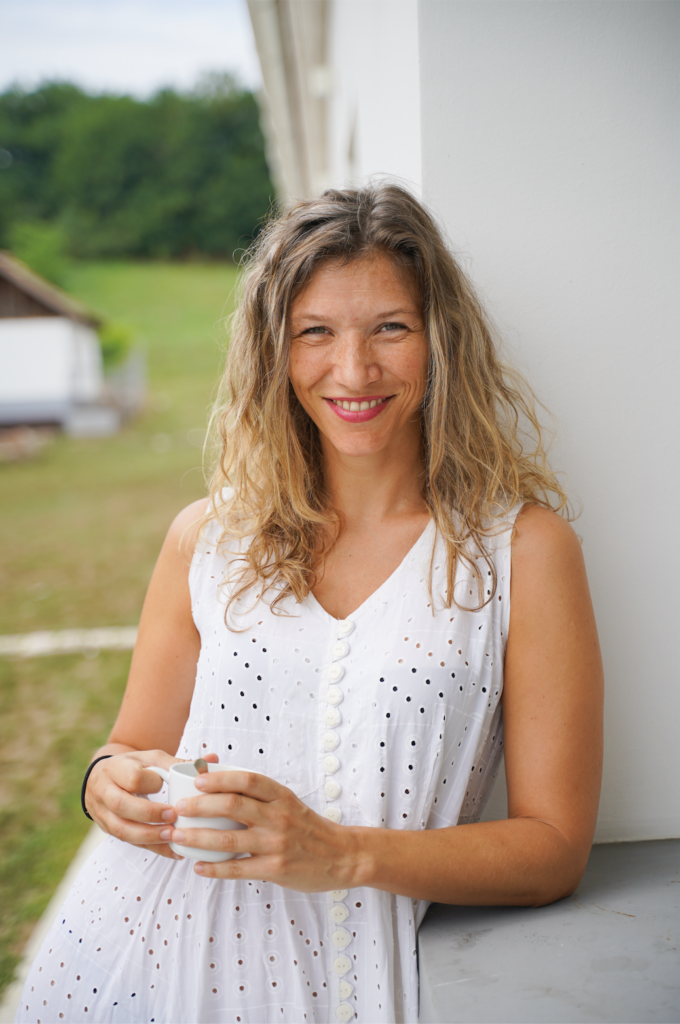
Zsófia Czakó was born in 1987 in Györ, Hungary. Her book, It is not Proper to Garden on Good Friday, (Nagypénteken nem illik kertészkedni) appeared in 2019 published by Scolar; it is now in its third printing. She is a recipient of a MasterCard Literary Scholarship. This award was based on a project for a memoir, Heartsound (Szívhang); that book was published in 2022, also by Scolar.
Marietta Morry and Walter Burgess, are Canadian. In addition to stories by Zsófia Czakó, they have translated works by five other Hungarian authors. Many of their translated stories by these authors, including five by Zsófia Czakó, have appeared in magazines in six countries, including in the New England Review, the Southern Review and Ploughshares. Gábor Szántó’s book “1945 and Other Stories,” six of its eight stories translated by them, was published in 2024.